Water · Plain language
The right answer depends on your mornings, not on the brochure.
Tank vs Tankless Water Heaters: What Actually Matters in a Rhode Island Home
Both make hot water. They do it differently, they fail differently, and the one that is right for your house depends on how the household actually uses hot water, what your water is like, what your basement allows, and how long you plan to stay. Here is the comparison without a sales pitch.
By SOS Plumbing & Heating · September 5, 2026 · 6 min read
How each one works, in one paragraph each
A tank water heater keeps a reservoir of water hot around the clock, whether anyone is home or not. When you open a tap, hot water leaves the top of the tank and cold water refills the bottom, and a burner or element brings it back to temperature over the following hour or so. Run the tank empty and you wait for it to recover.
A tankless water heater holds no water at all. When you open a tap, water flows through a heat exchanger and a burner fires hard for as long as the tap is open, heating it on the way through. Close the tap and it shuts off. Nothing is kept hot for nobody, and it never runs out in the sense a tank does.
The question that decides it: what does your peak hour look like?
Forget the brochure comparisons for a moment and picture a weekday morning in your house. How many showers, and are they back to back or at the same time? Does the dishwasher or the washing machine run while someone is in the shower? Is there a soaking tub that gets filled? That hour is what a water heater is really being asked to do, and it is where the two designs diverge.
A tank is limited by volume: it holds what it holds, and once the hot water is gone you wait. It handles simultaneous use fine, up to the point where the tank is empty. A tankless is limited by flow: it can heat only so much water per minute to temperature, but it can do that forever. It handles back-to-back use effortlessly, and it handles simultaneous use only up to its rated flow.
So a household of people who shower one after another, and who have ever run out of hot water, is a tankless household. A household where three things run at once for twenty minutes and then nothing for hours is a well-sized tank household, or a larger tankless. Neither is better in the abstract. One of them matches your mornings.
Rhode Island specifics that the national articles miss
Cold incoming water in winter
A tankless unit's flow rating is for a given temperature rise. In a New England January the water arriving from the street or the well is very cold, so the unit has to raise it much further to reach shower temperature, and its usable flow drops. A tankless that is comfortable in September can feel marginal in February if it was sized to the brochure rather than to Rhode Island. We size for the winter, not the average.
Hard water
Much of Rhode Island's well water and a good share of its municipal water is hard. In a tank, hardness settles as sediment that steals efficiency and eventually rots the bottom of the tank. In a tankless, it scales the heat exchanger, and a scaled exchanger runs hotter, works harder and dies young. The tank wants an occasional flush and an anode check. The tankless wants a descaling every year, without fail. If that yearly visit is not going to happen, the tankless advantage in lifespan quietly disappears.
Old basements and venting
A conventional tank vents up a chimney or a metal flue. A gas tankless is usually a sealed, direct-vent unit that exhausts through the sidewall in plastic pipe, and it often needs a larger gas line than the tank it replaces. In an old Rhode Island basement with a shared chimney, a tight mechanical room and gas piping sized decades ago, that is real work and it belongs in the quote, not in the surprise column.
Space
A tankless hangs on the wall and takes up roughly the footprint of a carry-on suitcase. In a basement where the water heater is eating a corner that could be storage, a workshop or a finished room, that is not a small thing.
Upfront cost, running cost, and how long it lives
A tankless costs more to install. The unit itself is more expensive, and the venting and gas work described above add to it. A tank is the cheaper day-one purchase, and for a house on a tight budget or a short horizon that settles it honestly.
Over the years the picture shifts. A tank spends energy all day keeping water hot for nobody, which is called standby loss; a tankless has essentially none, so it uses less fuel for the same hot water. And a tankless that is maintained runs roughly twice as long as a tank, with parts that can be replaced rather than a shell that rusts through. Whether that recovers the higher install cost depends on your fuel, your usage and how long you stay. For a family staying ten years or more it usually does. For a house you are selling in two, it usually does not.
Gas or electric changes the answer
Gas tankless units are the whole-house standard. Electric tankless units exist, but heating water instantly with electricity takes a great deal of power, and a whole-house electric tankless often needs an electrical service upgrade that Rhode Island panels were never built for. In an all-electric house the better efficiency conversation is usually a heat pump water heater, which is a tank that uses a fraction of the electricity, and which has its own rebate. In a gas house, gas tankless is the natural upgrade.
The third option: a combination boiler
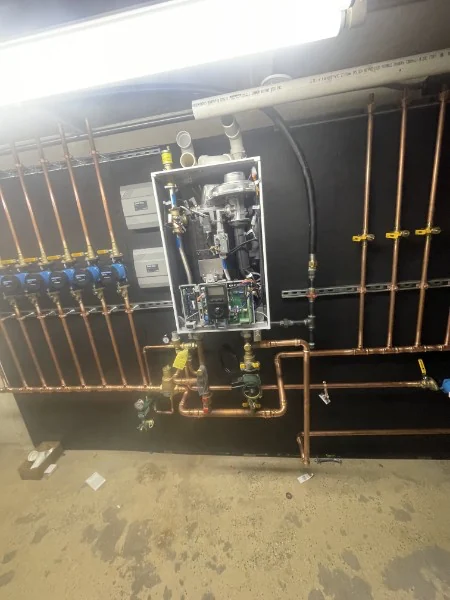
If your house heats with a boiler and the boiler is also due, a combination boiler does both jobs from one wall-hung unit: heat for the house and on-demand hot water for the taps. It retires the water heater and the old boiler together, frees the floor both stood on, and carries the largest of the current rebates. It is worth pricing alongside the tank-versus-tankless question rather than after it. More on our boiler replacement page.
The rebates, for 2026
Rhode Island Energy pays $600 toward an ENERGY STAR certified on-demand tankless gas water heater and $950 toward a combination condensing boiler with on-demand water heating, for equipment installed in 2026 by a licensed contractor at a home with a gas heating account. A qualifying storage tank gets $70. The heat pump water heater rebate for electric customers has been up to $600. Amounts, rules and deadlines are on our rebates page, and they change the arithmetic enough that they belong in the decision, not as an afterthought.
So which one?
A tank is the honest answer when the budget is tight, when the house is a short-term hold, when demand is modest and nobody has ever run out, or when the house is all-electric and a service upgrade is off the table.
Tankless is the honest answer when the household runs out of hot water, when people shower in sequence, when the basement space matters, when you are staying long enough for the running-cost and lifespan advantage to pay back, and when you will actually get it descaled every year.
We install both and we are certified Navien installers, which means we have no reason to steer you either way except the house in front of us. Tell us about your mornings and we will tell you which one fits.
Quick answers
The short versions.
Does a tankless water heater really give endless hot water?
Endless in duration, yes: it heats water as it flows, so it never runs out the way a tank does. Not unlimited in volume at once, though. A tankless unit has a maximum flow it can heat to temperature, and that maximum drops in a Rhode Island winter when the incoming water is very cold. Sizing to your peak demand is what makes the promise true.
Is tankless worth it in a house with hard water?
Yes, with one condition: annual descaling. Hard water scales the heat exchanger and shortens the life of a tankless unit that is never flushed. Most of Rhode Island's well water and a fair amount of its city water is hard enough to matter. Budget for the yearly service and tankless is a good fit; skip it and a tank would have been the better buy.
Can I go tankless in an all-electric house?
Sometimes. A whole-house electric tankless needs a great deal of electrical capacity, and many Rhode Island panels cannot supply it without a service upgrade. A gas tankless is the usual whole-house answer. In an all-electric house without gas, a heat pump water heater is often the better efficiency move, and it carries its own rebate.
How long does each one last?
A tank water heater in Rhode Island typically runs eight to twelve years, less on hard water. A tankless unit that is descaled annually is generally expected to run twenty years or more, and because its parts are serviceable it is usually repaired rather than replaced when something fails.